Evidence for learning beyond worksheets
How to document hands-on and interest-led learning clearly
Document cooking, nature study, field trips, building, experiments, conversation, and projects with concise factual context and representative evidence.
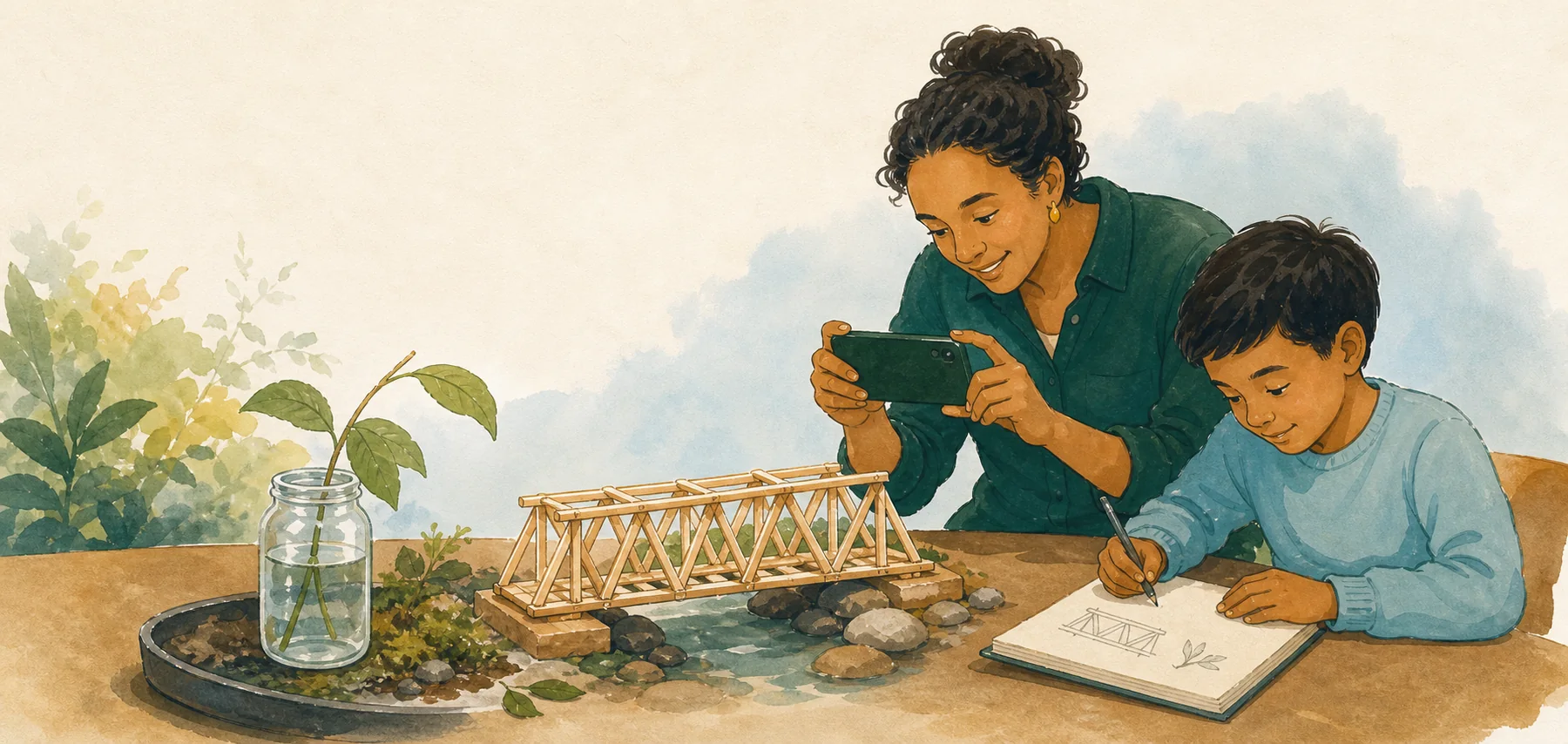
The short answer
Document hands-on learning with one concise factual note, the learner and date, a representative artifact or observation, and only the genuine subject or project connections. Describe what the learner did or demonstrated; do not inflate an ordinary activity into claims the evidence cannot support.
Start with what actually happened
Name the activity and observable learner actions before assigning educational language. “Measured and doubled three ingredients” is more useful than “mastered advanced mathematics through cooking.”
Preserve exact learner words only when they are truly quoted and their source is clear. Otherwise label the text as an adult observation or summary.
Choose one representative artifact
A photograph, sketch, measurement table, short audio reflection, project plan, or finished object may be enough. More files do not automatically make the evidence stronger.
Add the context the artifact cannot provide by itself: date, learner role, materials, question, change, or result.
Connect only what genuinely applies
Many practical activities cross subjects, but broad connection should not become keyword stuffing inside the learning record. Add subjects, goals, books, or projects that are supported by the activity.
If a connection is an adult interpretation rather than something the learner demonstrated, keep that distinction visible.
Revisit evidence when an output needs it
Daily capture should stay light. Later, select a small number of useful moments for a portfolio, project report, course narrative, or progress review.
This separation protects family time and produces better outputs than attempting to write formal report language after every activity.
Fictional worked example
Three fictional hands-on learning records
Each example is intentionally concise and avoids claims the evidence cannot establish.
| Selection | Evidence | Why it belongs |
|---|---|---|
| Cooking | Scaled a bread recipe from 4 to 6 servings and checked each quantity | Records the mathematical action without claiming broad mastery. |
| Nature study | Photographed two leaf arrangements and made labeled comparison sketches | Keeps the observation and representative artifacts together. |
| Building project | Revised a cardboard bridge after the first span bent under five books | Shows testing and iteration using an observable result. |
Privacy and accuracy boundaries
- Do not include unrelated people or identifying location details in photographs.
- Separate factual description, adult interpretation, and learner reflection.
- Avoid diagnostic, grading, or mastery claims that the evidence cannot support.
- Keep the original private; share only a reviewed derivative when needed.
Frequently asked questions
Does cooking count as homeschool learning?
Cooking can provide meaningful evidence of reading, measurement, planning, science, or practical skills when those actions genuinely occurred. Whether it satisfies a formal requirement must be verified separately.
How do I document a homeschool field trip?
Record the date, place at an appropriate privacy level, purpose or question, what the learner did, and one representative reflection or artifact. Avoid collecting unnecessary location or bystander information.
Can one activity connect to multiple subjects?
Yes, when each connection is genuine. Storianna allows a learning moment to connect across relevant subjects and projects without duplicating the underlying evidence.
Apply this privately to your own records
Public examples explain the method. Your learners, evidence, notes, selections, and saved outputs belong inside the private household workspace.
Capture a learning moment privately